
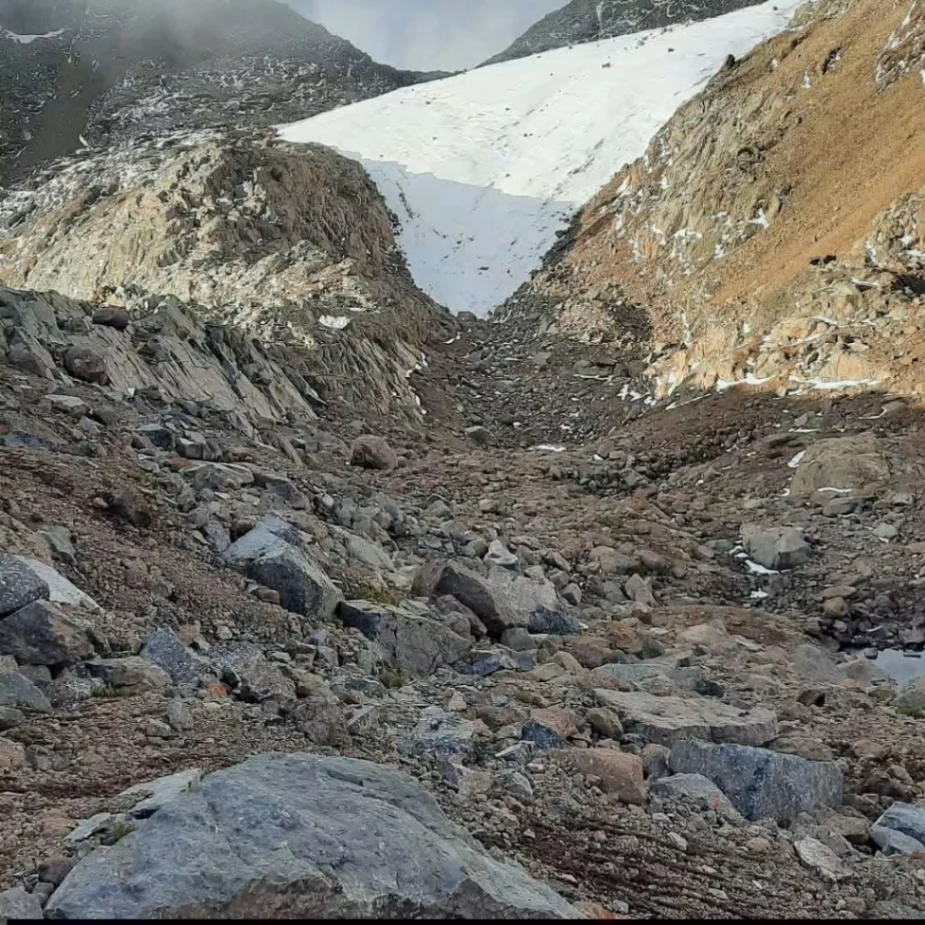
A glacier in retreat
The Lewis Glacier: A Name That Outlived the Ice
High on the slopes of Mount Kenya lies a piece of Africa's natural history that is slowly disappearing — the Lewis Glacier.
Its story stretches back more than a century, to the early days of scientific exploration of Mount Kenya.
In 1893, British geologist John Walter Gregory explored the mountain and documented its glaciers and geological features. Among them was a glacier he named the Lewis Glacier, in honour of American geologist Henry Carvill Lewis, whose work had made important contributions to the understanding of glacial geology. Gregory also gave the names of other scientists to features on Mount Kenya, including the Tyndall Glacier.
More than 130 years later, the name Lewis found itself at the centre of another remarkable chapter in the glacier's history.
In December 2025, South African-British endurance swimmer and UNEP Patron of the Oceans Lewis Pugh travelled to Mount Kenya as part of the Mount Kenya Glacier Swim expedition. His ambition was to reach Tarn Lewis, a small high-altitude tarn situated at roughly 4,850 metres above sea level beneath the glacier, and conduct a symbolic swim in its freezing waters.
The objective was not simply adventure.
Pugh's expedition was intended to use the dramatic setting of Mount Kenya to highlight the rapid disappearance of Africa's remaining glaciers and draw international attention to the changing environment at high altitude.
But the planned swim never took place.
As Pugh approached the summit region, the expedition team was informed that the swimming and filming activities near the glacier could not proceed because of environmental regulations and local concerns.
The expedition nevertheless succeeded in putting Mount Kenya's shrinking ice into the spotlight.
A glacier in retreat
The Lewis Glacier is a shadow of what it once was.
Mount Kenya is among only three African mountain regions where glaciers still remain, together with Mount Kilimanjaro in Tanzania and the Rwenzori Mountains in Uganda and the Democratic Republic of Congo.
Over the decades, the glaciers on these mountains have undergone dramatic retreat. Mount Kenya's remaining ice is particularly vulnerable, with scientific assessments indicating that its glaciers could disappear within the coming years, with some projections pointing towards around 2030.
That possibility gives the Lewis Glacier significance far beyond its appearance.
A glacier may look like an isolated frozen landscape high above human activity, but Mount Kenya's environment is part of a much larger ecological system. The mountain's forests, wetlands, streams and other high-altitude ecosystems contribute to water systems that sustain communities, agriculture, wildlife and economic activity far below its peaks.
The glaciers themselves are only one component of that water system. Their retreat should therefore not be interpreted as meaning that the mountain's entire water supply depends on glacial melt.
Instead, the vanishing ice serves as a highly visible signal of the environmental changes occurring across Africa's high mountain ecosystems.
Two Lewises. One glacier.
There is an intriguing coincidence in the story.
The Lewis Glacier was named in the nineteenth century after Henry Carvill Lewis.
More than a century later, another Lewis — Lewis Pugh — stood before the same glacier while attempting to draw attention to its disappearance.
Pugh did not give the glacier its name. The connection existed long before he was born.
Yet the coincidence creates a powerful historical thread.
In 1893, Gregory encountered Mount Kenya's glaciers as extraordinary and enduring features of an equatorial mountain.
In 2025, Pugh climbed the mountain to call attention to the fact that those same glaciers are now vanishing.
The name has endured.
The ice has not.
A disappearing chapter of Africa's natural history
The Lewis Glacier is more than a spectacular feature for climbers, photographers and adventurers.
It is a fragment of Africa's environmental history.
Its ice preserves evidence of past climatic conditions, while its retreat provides a highly visible reminder that mountain environments are changing.
One day, future generations may stand on Mount Kenya and look at photographs of the glacier rather than seeing the landscape exactly as it appears today.
That is what makes the Lewis Glacier story so compelling.
It connects exploration, science, adventure and conservation across more than a century — from Gregory's expedition in 1893 to Pugh's journey in 2025.
Mount Kenya is not simply a peak rising above the Kenyan landscape.
It is a living record of environmental change.
And the Lewis Glacier may be one of the clearest pages in that record — a reminder that some of Africa's most extraordinary landscapes are not permanent.