
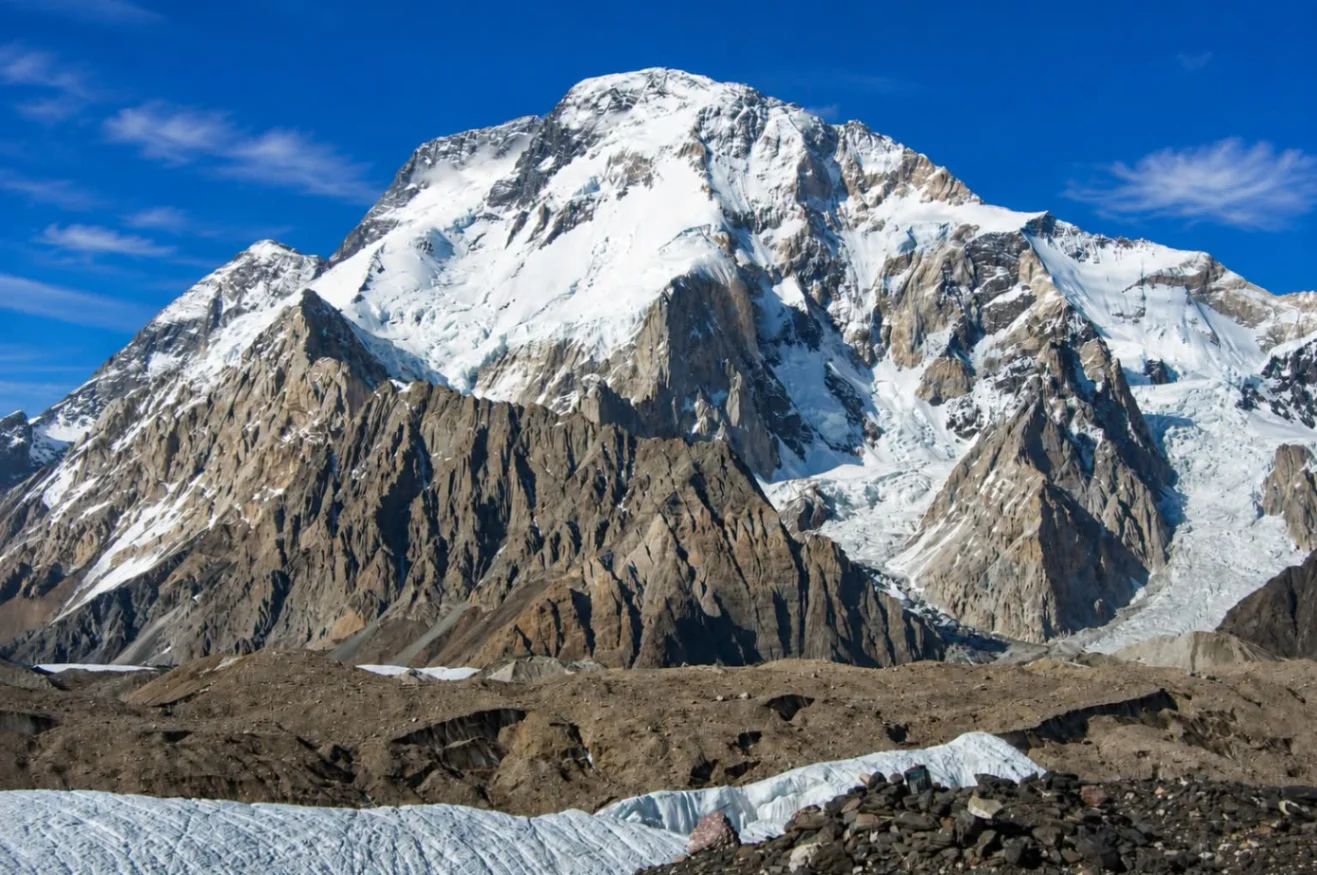
BROAD PEAK
BROAD PEAK: THE GIANT THAT HIDES ITS TEETH
At 8,051 meters, Broad Peak looks almost gentle from a distance.
Its long, wide summit ridge gave it the name climbers still use today. Compared to the sheer walls of K2, standing just eight kilometers away, Broad Peak seems approachable. Almost friendly.
That is exactly what makes it deadly.
THE BASICS
Broad Peak is the 12th highest mountain on Earth. It sits on the border between Pakistan and China, deep in the Karakoram range. It has three summits: Main, Central, and North, all connected by that famous curving ridge.
In 1957, an Austrian team of four climbers reached the top without supplemental oxygen and without high altitude porters. Hermann Buhl, Kurt Diemberger, Marcus Schmuck, and Fritz Wintersteller made history that day. Buhl would die on a nearby peak just weeks later.
WHY CLIMBERS UNDERESTIMATE IT
The approach looks manageable. The slopes look moderate. Many climbers use it as a warm up before attempting K2.
That confidence has cost lives.
WHY IT IS ACTUALLY ONE OF THE MOST DANGEROUS MOUNTAINS ON EARTH
The summit ridge is brutally long and fully exposed. Climbers spend hours above 8,000 meters in the death zone, where the body is dying with every breath, oxygen or not.
Weather in the Karakoram turns without warning. A clear morning can become a whiteout in an hour, trapping climbers high on the mountain with no visibility and no shelter.
The false summit has fooled experienced mountaineers for decades. Many have turned back believing they reached the top, only for others to push on into deteriorating conditions chasing the true summit further along the ridge.
Avalanches and hidden crevasses guard the lower slopes. The Karakoram is remote, rescue is slow, and help can be days away.
Broad Peak does not announce its danger. It waits for climbers to relax.
THE HUMAN COST
Since 1957, dozens of climbers have died on its slopes. Some vanished into storms. Some fell from the ridge. Some simply ran out of strength in air that offers a third of the oxygen the body needs.
Every one of them looked at that wide, gentle looking summit and believed it would be easier than it was.
THE LESSON
The most dangerous mountains are not always the ones that look terrifying. Sometimes the real danger is a summit ridge that lets you relax just enough to make a fatal mistake.
Respect the mountain. Every time. No matter how gentle it looks from base camp.
Verified sources: American Alpine Journal, Himalayan Database, Karakoram climbing history archives, accounts from the 1957 Austrian expedition