
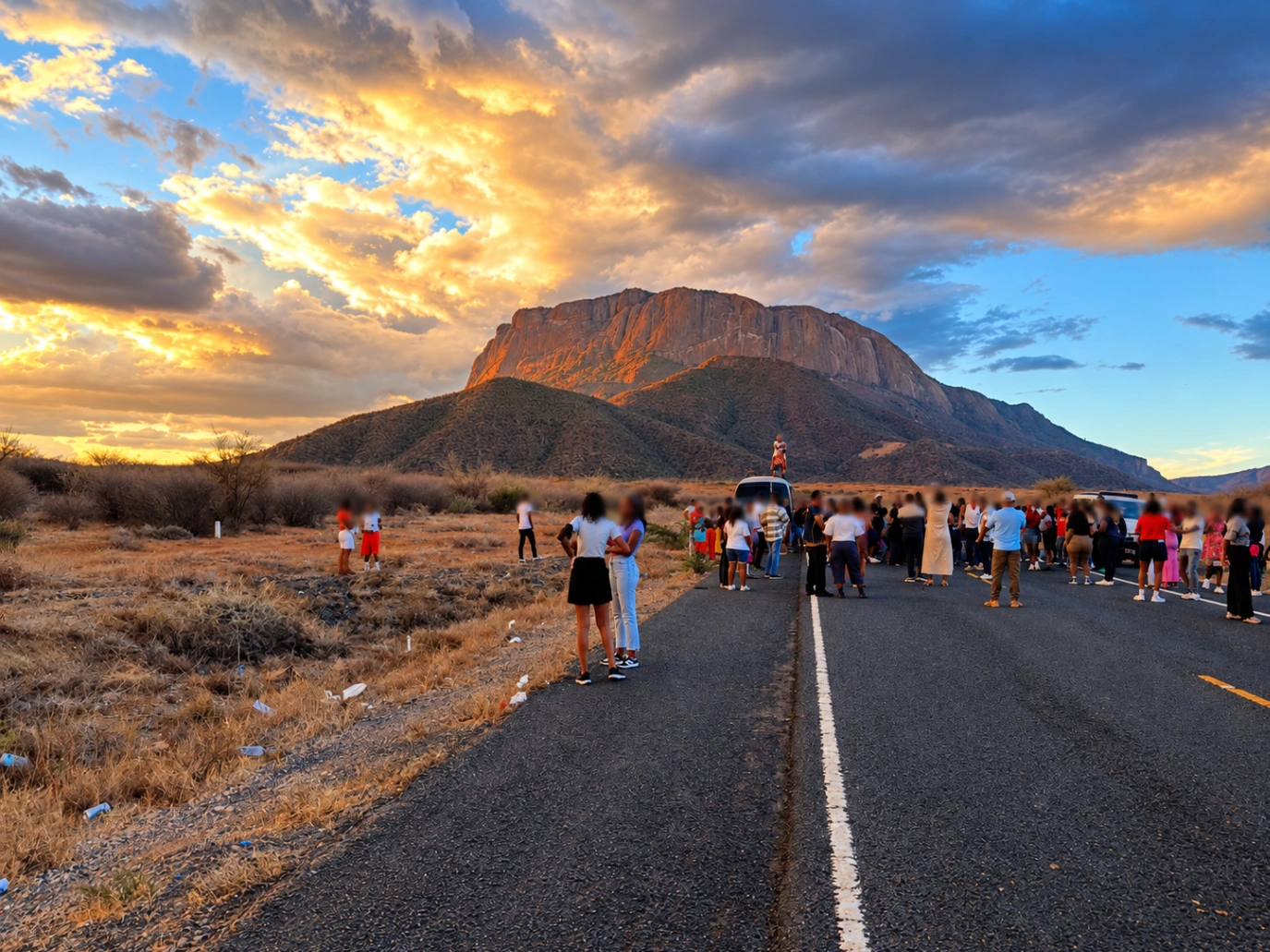
MT OLOLOKWE-WHEN THE HIGHWAY BECOMES A DANCE FLOOR
THE OLOLOKWE TIME BOMB: WHEN THE HIGHWAY BECOMES A DANCE FLOOR
A scenic road, a social-media moment and a potentially deadly gamble. Who will take responsibility before tragedy strikes on the Isiolo–Marsabit highway?
By Trek Sports & Adventures | Opinion
There is something magical about the road to Samburu. The vast landscapes, the rugged beauty of northern Kenya and the magnificent silhouette of Mount Ololokwe make the journey an adventure in itself. For road-trip enthusiasts, photographers and nature lovers, it is one of those journeys that remind us why we travel.
But something troubling is emerging around the culture of road trips to Ololokwe.
A public highway is increasingly being treated as a stage for photography, dancing and social-media content. People step onto the tarmac, strike poses, dance in groups and record videos, while vehicles stop or manoeuvre around them.
A recent video showing people dancing on the road raises an uncomfortable question: Are we so desperate for the perfect photograph that we are willing to gamble with human life?
A highway is not a photography studio
The Isiolo–Marsabit road is an important transport corridor. It serves local communities, commercial traffic, tourists and travellers moving across northern Kenya.
Every vehicle on that road carries people with families, responsibilities and destinations to reach. A driver approaching a bend may not anticipate finding a group of people occupying the carriageway for a dance routine.
A moment of excitement can become a nightmare in seconds.
A distracted driver, a sudden emergency manoeuvre, a heavy truck that cannot stop in time or a vehicle approaching at an unexpected speed could turn a harmless-looking video into a scene of devastation.
And unlike a deleted social-media post, the consequences of a road accident cannot simply be edited out.
This is why the situation deserves attention before somebody loses a life.
The dangerous economics of going viral
Social media has changed the way people experience travel. We no longer visit places merely to see them; increasingly, we want to prove that we were there.
The photograph must be spectacular. The video must be entertaining. The dance must be memorable. The content must attract views, shares and reactions.
But when the pursuit of online attention begins to compromise public safety, we must question our priorities.
What is the value of a thousand likes if the price is a human life?
There is nothing wrong with taking photographs at Ololokwe. There is nothing wrong with dancing, celebrating friendship or enjoying a road trip. These are legitimate expressions of adventure and leisure.
The problem arises when people occupy an active traffic lane without adequate safety measures, exposing themselves and other road users to unnecessary danger.
The mountain will still be beautiful from a safe viewpoint. The memories will still be worth keeping. The content can still be created without turning the highway into a potential accident scene.
Who takes responsibility when tragedy strikes?
This is where the conversation becomes more serious.
Who is responsible when a road-trip organiser encourages a stop in a dangerous location? What responsibility do participants have when they step onto a live carriageway? What should motorists do when they encounter crowds obstructing the road? And what measures should relevant authorities take when such behaviour becomes a recurring concern?
These are not questions we should postpone until an accident occurs.
Tour operators and road-trip organisers must establish clear safety protocols. Stops for photographs should be made at suitable locations away from moving traffic. Participants should be briefed before departure, and drivers should never be pressured to stop in unsafe places simply to accommodate a photograph or video.
Participants also have a responsibility to exercise common sense. A group decision does not make a dangerous action safe.
Relevant road-safety authorities should assess the situation, enforce applicable traffic laws and work with tour operators and local stakeholders to identify safe stopping points where appropriate.
Prevention is far cheaper than the human cost of a preventable tragedy.
Adventure must never come at the expense of safety
At Trek Sports & Adventures, we believe travel should be about exploration, connection, discovery and respect for the places we visit. The journey matters just as much as the destination.
But responsible adventure requires discipline.
We cannot celebrate the beauty of northern Kenya while ignoring the safety of the people travelling through it. We cannot promote tourism while disregarding the communities and transport networks that make tourism possible.
Nor should this conversation become an attack on road-trip enthusiasts. The answer is not to discourage travel to Ololokwe. It is to make that travel safer and more responsible.
Kenya has extraordinary destinations that deserve to be explored. We should be encouraging more people to discover them, not normalising behaviour that could put travellers and other road users in danger.
A warning we should not ignore
The video of people dancing on the highway should prompt a serious public conversation about road-trip safety. It does not, by itself, establish that an accident is imminent or that a particular offence has occurred. But it illustrates a risk that deserves to be addressed before circumstances take a tragic turn.
A highway is shared public space, not a private event venue.
The question is not whether we should enjoy Ololokwe. We absolutely should.
The question is whether we can enjoy it without putting lives at risk.
Let us take the photographs. Let us dance. Let us explore northern Kenya. Let us create memories worth sharing.
But let us get off the road before the road claims a life.
Because the real measure of a successful road trip is not how many views the video attracts. It is whether everyone who left home returns safely.
Leave nothing behind but footprints.
— Trek Sports & Adventures